


The current agriculture industry is designed to keep sick plants alive long enough to produce a crop. It keeps farmers in debt, plant health low and as a result, human health in decline.
As the public shies away from GMO, pesticides and other ‘conventional’ farming practices, the industry has to find new ways to keep the money flowing. Enter mRNA foliar applications (sprays). They have a singular intent, to enable or disable a gene in a target species to (virus, fungus, insect or beetle) in order to prevent plant mortality. As with all new tech, there are unexposed risks and of course word magik games and these ‘Gene-Silencing Pesticides’ are no different.
Word Magik!
Here are some interesting ‘word magic’ connections related to mRNA tech.
1. One company making news headlines is ‘Apolo Biotech’ in Argentina. [The spelling is correct.]
2. Apollo was a Greek god who ruled over many things. He was the god of the sun, healing, disease, plague, agriculture, prophesy and medicine. He is also a god of ‘divine distance’.
Divine distance means, Apollo, from on high, made ‘man’ aware of his own guilt and purified him of that guilt. Apollo had his own cleansing ritual. He killed the serpent Python which was considered murder. As a result he fled and served as a cow shepherd for nine years and returned ‘cleansed’. Sounds a lot like sin-eating.
If you put that all together, it starts to paint a picture of the Catholic Church + Medical Industry = Apollo in action.
3. The active ingredient in these new biopesticides is named Ledprona.
4. The word Ledprona shares the same Hebrew Gematria value as Madness, Stalin, The Angelic Code, Go To Hell, Hail Hitler, Phobos and ‘American Famine’!
In my opinion, the agriculture industry has found another income stream that is completely unnecessary. As public awareness against GMO and chemical pesticides grow, new financial assets are needed. The problem with mRNA foliar sprays, also know as spray-induced gene silencing (SIGS) technology is the ever-present potential for unintended consequences.
Risks!
The production of mRNA sprays is challenging because they degrade rapidly. To combat this, biotech companies are researching nanomaterials to increase the stability of the compounds. What happens if the stability gets out of hand and these become similar to persistent ‘forever chemicals’?
No one has studied the risks for farmers. The EFSA (European Food Safety Authority) classifies them as safe because the chances of consumption are very low. There still remains a void in regulation, environmental impact and long term health studies for this technology.
No one has studied accidental gene suppression in beneficial beetles. In Canada, there are almost 400 species of predator beetles who eat pests like cutworms, moths, mites and even weed seeds. There are 450 species of lady bugs who feed on aphids, mites, and insect eggs. The accidental cross-targeting of beneficial insects is largely unstudied.
In human studies mRNA research is often hampered by the body having an accelerated immune response such as inflammation.
At the core of inflammation is usually a leaky gut, which allows dangerous bacteria and other foreign bodies to get into the bloodstream. That triggers a rapid immune response which is categorized by the medical industry as inflammation. It is useful to note that pesticide residues are also known to cause leaky gut. Will eating plants treated with mRNA have similar effects?
Nature Will Find a Way.
Pesticides are counter to the way nature operates. Plants not fit for purpose are consumed by the bacterial/fungal/insect world. Nature culls the sick for the survival of the species. If a species dies off, a new one more adapted to the environment takes over (aka weeds). Dan Kitteridge calls it the ‘Farmers Report Card’. If your plants are sick and cannot feed or defend themselves, you fail as a farmer.
If these mRNA sprays do work, the result will be more SICK plants are kept alive to continue the financial harvest. The sprays are designed to target the species that feed on sick plants. Beetles, for example, are highly adapted to eat plants that are considered toxic, like potato leaves. The sprays are designed to turn off the gene that gives them this advantage. If the insects lose the ability to digest the plants, they starve. Is anyone asking what happens to the human digestive system if this new mRNA makes it into the gut lining? Will the body lose the ability to absorb nutrients or worse?
My bet is that nature will find a ‘novel’ way to cull these unhealthy plants anyway. This could be in the form of a different strain of bacteria/fungus or an insect could enable a new gene that would make them immune from mRNA attacks.
Gene expression is related to environmental conditions. There are many studies that prove this. There is one in which a bacteria strain that could not digest lactose was placed in a petri dish. They were fed 100% pure lactose. As expected they died. Well, most of them died. A very small percentage of the bacteria expressed a new set of genes and ‘learned’ to digest lactose. Nature will always find a way. Genes are activated or disabled depending on the environmental conditions and no amount of technology will change that. It is the operating system of life.
There is an Easy Solution.
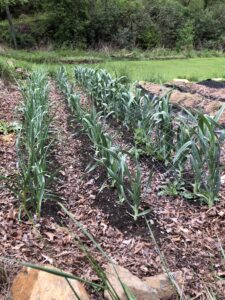
What farmers need is to revert back to regenerative agriculture. Sick plants cannot defend themselves and should be removed from the food chain. The solution is to provide the infrastructure for HEALTHY plants who will reach maturity faster which in turn means they can make their own defences. This will result in more nutritious crops which will help make people healthier and keep them out of the medical industry.
According to John Kempf, a vocal proponent of regenerative agriculture, plants go through 4 stages of growth. The first two phases are based on balanced bio-chemistry. Providing the correct minerals and chemical compounds allows the plant to maximize energy production (healthy dark green leaves). This is simple to accomplish and much more affordable than conventional fertilizers. It is also compounding. That means less and less is needed as the soils heal season after season.
Modern agriculture barely scratches the surface of phase 1, let alone phases 2 to 4. For modern farmers, fertilizers are completely necessary to just keep plants viable. The analogy is a person on life support in a hospital. Without the IV drip (fertilizers), the patient dies. The same is true for modern plants.
Phases 3 and 4 are dependent on symbiotic relationships between the plant and the microbiome of the soil. Once a plant is sufficiently mature, it can orchestrate the life in the soil to produce metabolites to allow the plant to develop multiple layers of protection. These are in the form of waxes, oils, and flavanols/bioflavonoids. These compounds are highly protective and also highly energy intensive for the plants to create. It is useful to note that the Jenna Experiment in Germany showed that plant bio-diversity of at least 4 different plant families greatly enhanced the symbiosis of the soil life. When you make observations you often find cooperation is the corner-stone of thriving natural systems.
At stage 4, even beetles, the hardest insect to control, can no longer eat the plants. Fully mature plants are now fit for animal/human consumption. They are likely to taste better, have higher weight densities and will be healthier (more nutrient dense) than conventionally grown plants.
What farmers consider normal today is likely only 20 to 30% of the genetic potential of healthy plants. But it does not have to be that way. In as little as 2 to 4 seasons, farmers can make the switch from conventional to regenerative agriculture and regain the role of ‘land steward’ instead of ‘exterminator’.
Further reading on the 4 phases of plant health can be found here:
https://advancingecoag.com/
You can learn more about the risks mRNA technology in the Friends of the Earth report here:
https://foe.org/wp-content/
and https://foe.org/issues/food-